

23 Feb SOGNO SONO 2025
Enzo Minarelli
SOGNO SONO
2025
I sogni di Enzo Minarelli
Nello sterminato numero di opere d’arte e di pubblicazioni scientifiche e letterarie dedicate ai sogni, il nuovo libro di Enzo Minarelli potrebbe apparire privo di originalità, non fosse che quattro anni di paziente e meticolosa raccolta di sogni reali, accompagnata da tecniche di potenziamento di capacità mnemoniche appositamente coltivate, attestano che non si tratta né di un’arida prova di stile né di un ordinario esercizio diaristico.
Attingendo alla nota antologia di Jorge Luis Borges, del resto, trovo un verso fulminante di Antonio Machado: “Di tutta la memoria vale solo il dono eccelso di ricordare i sogni.”[1] E non importa se Machado si riferisce ai desideri più o meno soddisfatti, mentre Minarelli racconta sogni veri e propri, perché la loro sostanza può ben essere la stessa.
Isolare e portare in primo piano la metà generalmente inconoscibile di una storia personale rimette infatti in questione lo stesso concetto di attendibilità delle usuali ricostruzioni biografiche, generalmente del tutto prive di quella che è a tutti gli effetti una parte rilevante e costitutiva dell’esperienza (non solo) umana: il desiderio quanto il sogno.
In apertura del libro, la frase di Fëdor Dostoevskij appare come un aforisma di non pacifica interpretazione. Ma l’affermazione del sognatore delle Notti bianche, isolato nelle sue fantasticherie ad occhi aperti, non può essere disgiunta dagli altri testi dello scrittore, che fa ammettere proprio al protagonista di questo racconto che “una vita del genere è un delitto e un peccato”.
Eccoci dunque avviati a entrare in un universo immateriale infestato di peccati e di delitti, che tuttavia, se prodotti nel sonno, sappiamo essere così involontari da essere esenti da colpe e da castighi. Sempre da Borges, a questo proposito, traggo un’altra citazione, riportata dalle Confessioni di Sant’Agostino da un autore fittizio, Rodericus Bartius: «Non a causa di me è accaduto, ma in me. E, tra me e me, che differenza!». Perché allora esporre questi crimini, perché confessare senza censure ciò che è così interamente intimo e fuori dal proprio controllo, uscendo da una zona di sostanziale immunità? Forse perché, come commenta l’immaginario Bartius, “solo un santo può restare tranquillo sapendosi irresponsabile”?[2]
Non voglio sostituirmi a Enzo Minarelli per tentare una risposta, violando l’inafferrabilità delle sue intenzioni. Tuttavia posso, come lettrice, osservare i tanti aspetti di un percorso di significazione che l’artista manifesta attraverso una formalizzazione molto più sofisticata di quanto appaia a prima vista. Il libro si presenta come un complesso coordinato di dettagli scelti deliberatamente, ciascuno in grado di smuovere sterminate sedimentazioni di saperi, consuetudini, simbologie e preconcetti.
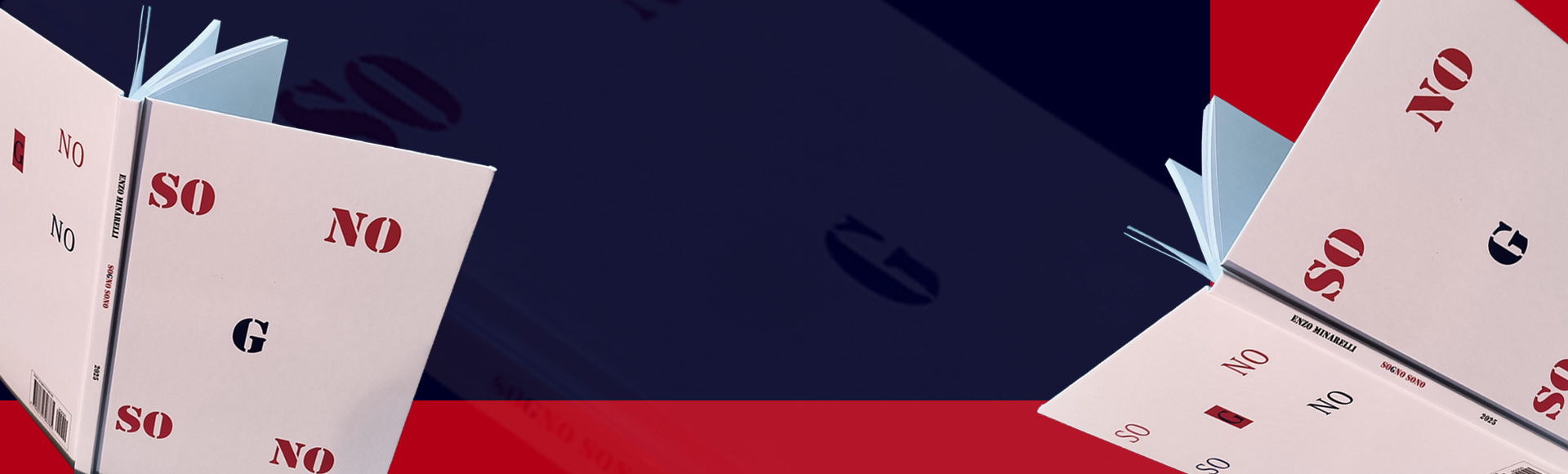
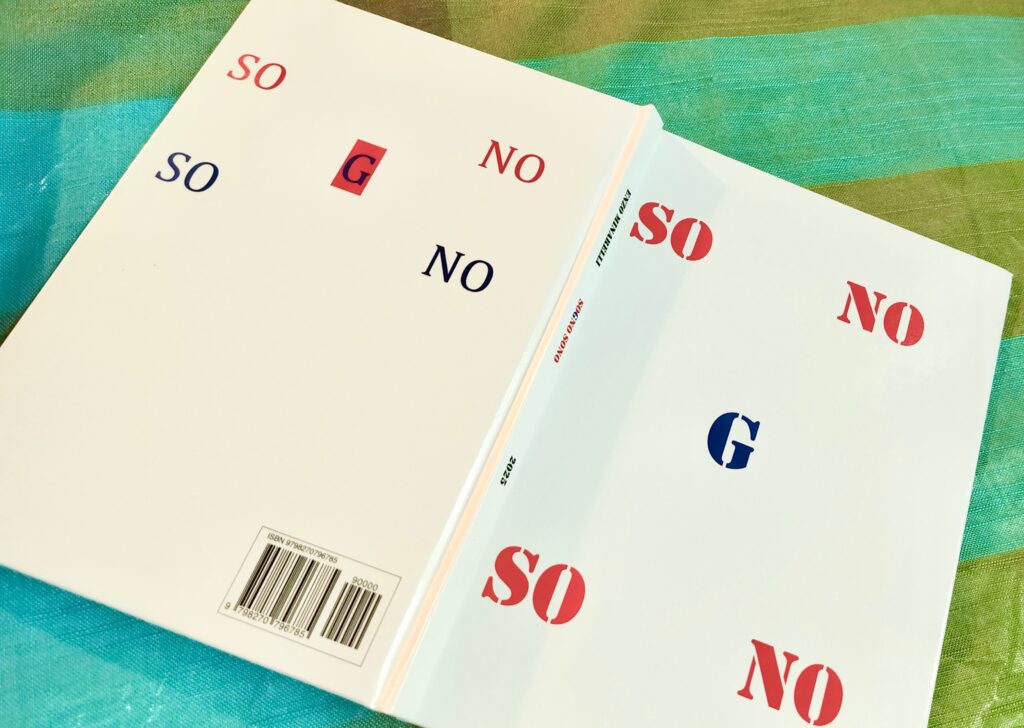
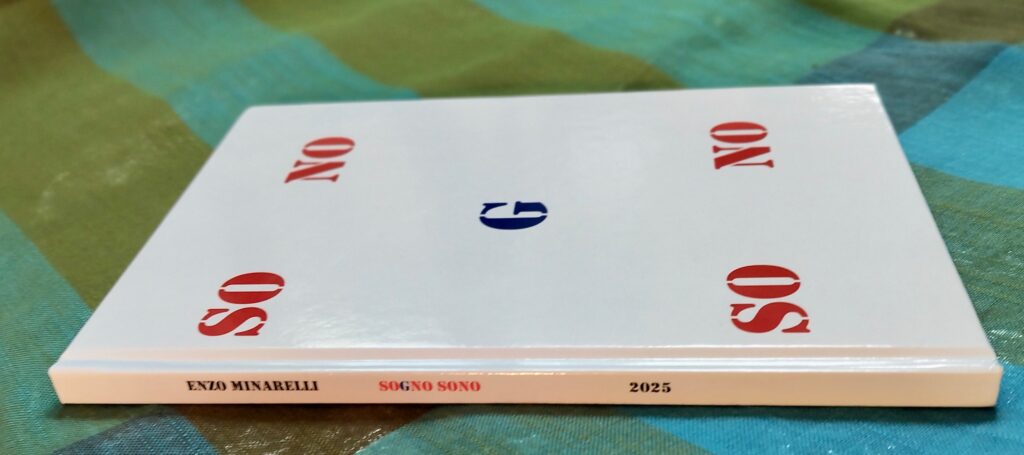
La copertina, costruita come una sorta di quadrato magico che rende incerta una lettura univoca, è già la manifesta esposizione di un enigma. La G blu, posta al centro di un ipotetico campo araldico occupato dalle sillabe in rosso che compongono la parola SO-NO, equipara immediatamente verità del sogno e verità dell’essere, in una tessitura indistinguibile di conscio e inconscio.
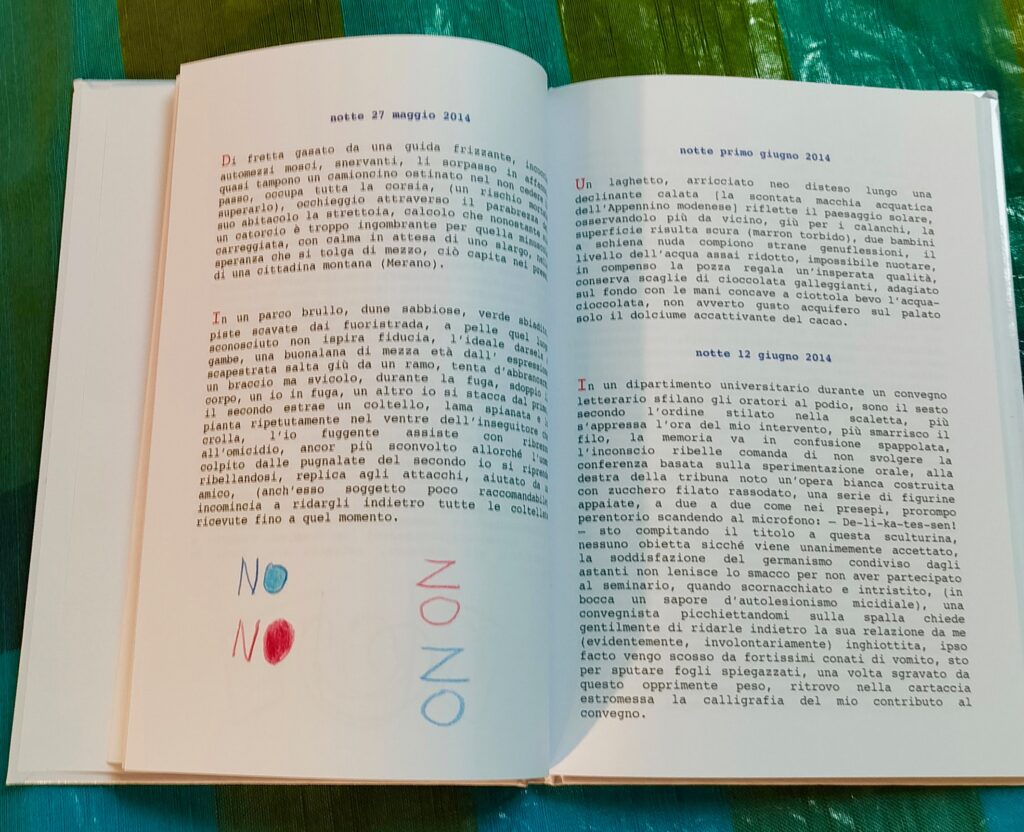
Sulla scelta del rosso e del blu – colori puri da stemma, bandiera, scudetto – si potrebbe poi divagare a lungo, dopo le lezioni di Michel Pastoureau, ma basta la elementare constatazione che si tratta di due colori che designano da sempre i due poli di una lunga serie di antinomie, e elementi contrapposti come l’acqua e il fuoco. Sono anche, per me, i colori dell’ormai desueto lapis a due punte rosse e blu, con cui i maestri sottolineavano e distinguevano gli errori perdonabili, che costavano un meno o due, e quelli gravi, che potevano valere un punto intero. Non che questo abbia un nesso reale con le date in blu e le iniziali in rosso che avviano i singoli sogni nel libro di Minarelli, eppure questi colori fanno risuonare in me l’eco di un allarme, di una spinta perentoria a prestare attenzione.
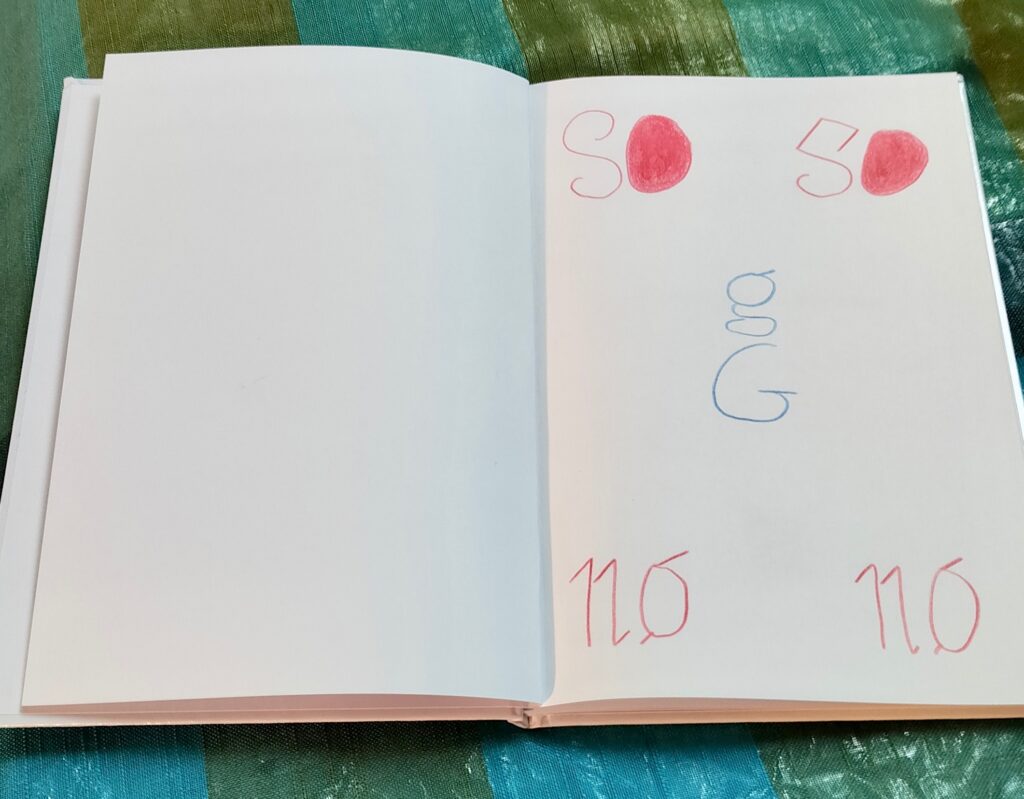
La messa in evidenza delle lettere iniziali rimanda all’uso dei capilettera nei codici miniati, tanto spesso dipinti di rosso e di blu. Della tradizione amanuense il libro è del resto attiva ripresa, dato che delle lettere che compongono il titolo Minarelli esegue manualmente, in varie parti rimaste in bianco, molteplici varianti calligrafiche, esplorandone anche visivamente la potenzialità espressiva. Le diverse combinazioni delle quattro lettere che compongono il titolo, i tratti sinuosi o spezzati, i pieni o i vuoti, sono equivalenti visuali delle tante intonazioni e pronunce vocali di cui sono passibili, quanto delle emozioni e dei fatti che possono trasmettere.
L’accento posto sulla lettera S, che in una rivelazione finale l’autore comunica di avere soppesato con la bilancia di un altro artista, Gastone Novelli, a cui il libro è dedicato, è per me indissociabile dall’elenco di parole che iniziano per S delle Milleuna di Nanni Balestrini e dalla magistrale esecuzione che ne ha lasciato Demetrio Stratos – nomi presenti nell’evoluzione umana e artistica di Enzo Minarelli. E, ancora, il mio pensiero va al lungo titolo dell’articolo di Germano Celant apparso sull’unico numero della rivista “Senzamargine” (1969): Sensorio, sensazionale, sensitivo, sensibile, sentimentale e sensuoso. Lettera massimamente suggestiva, dunque, che almeno a me viene spontaneo saldare ideograficamente all’immagine del serpente di un vecchio abbecedario e onomatopeicamente al sibilo che ne rappresenta le manifestazioni sonore. Ma, appunto, l’autore ci ricorda che Novelli affermava che la S di serpente non può essere scritta con la S di seno, e visualizza la differenza scrivendo in rosso l’iniziale della prima parola e in blu quella della seconda.
Ma non meno importante è la lettera o, anche a seconda di come viene pronunciata nella parola SONO. Sono / sòno, vita e produzione di suoni, dunque, come matrice / metrica della poesia. Quanto alla n, non ne va certo sottovalutata la morbidezza, capace di addolcire perfino la severa gutturalità della g.
Lo stile di racconto dei sogni, tradotto tipograficamente con i caratteri di un articolo battuto a macchina, è lineare e asciutto come un pezzo di cronaca. Non ci troviamo però alle prese con un linguaggio semplice e colloquiale, perché, come sempre nelle opere di Minarelli, precisione lessicale e musicalità intrinseca delle parole e della ritmica sono trattate con la massima cura. Non c’è alcun tentativo di mimesi del modo in cui i sogni si presentano effettivamente, totalmente sganciati dalle coordinate spazio / temporali esperibili nella realtà. Nessuna concessione, neppure incidentale, allo stream of consciousness o a qualsiasi forma di automatismo. Minarelli sceglie quindi una scrittura “razionale” e forme narrative semplici, ma non elementari, per addomesticare il conturbante.
Termino qui il mio tentativo di indicare le molteplici catene paradigmatiche a cui è forse possibile ricondurre questo dispiegarsi di una personalissima cosmogonia compendiata nel libro, vero e proprio theatrum di saperi e atto e strumento performativo.
Si dovrebbe certamente continuare sondando compiutamente i dispositivi retorici impiegati, ormai perfino d’istinto, da un polipoeta consumato come Minarelli, ma a questo non sono purtroppo addestrata. In ogni caso, il mio è solo uno dei modi possibili per avvicinare la materia scottante del libro, che è poi l’idea di dare dignità narrativa al sogno in sé e per come è. Non come artificioso genere o espediente letterario, non come sintomo patologico o forma di introspezione, non come strumento divinatorio o profetico, non come luogo di desideri non consumati e di paure sotterranee, ma come esperienza effettivamente vissuta, che non esclude tutte queste cose ma nega la necessità di assumerle come pretesto per dare legittimità alla propria esposizione. Un racconto, una biografia, che non abbisogna di altra dimostrazione che della sua verità.
Se il sogno condensa la summa di ogni nostra interiore conoscenza razionale e irrazionale, presentandola senza filtri e convenzioni, lo possiamo anche intendere come il campo dell’autentica creazione. È qui che la sua narrazione si accorda allora con l’instancabile cimento dell’arte, con quell’impegno mai veramente ripagato a generare e perfezionare una lingua che dica il vivere.
—–
[1] Distico finale del componimento LXXXIX, in Poesìa y Prosa. Poesìas completas, Espasa Calpe, Madrid 1989, p. 487, cit. in J. L. Borges, Libro di sogni [1995], Adelphi Edizioni S.p.A., Milano 2015. p. 99. Il testo della poesia, in un’altra traduzione, è il seguente: E ti potrai conoscere, riandando / l’oscura tela di quanto sognasti, / in questo giorno triste che cammini / ormai con gli occhi aperti. / Di tutta la memoria, quel che vale / è solo il dono di evocare i sogni.
[2] J. L. Borges, idem, p. 144. Il passo di Sant’Agostino è riferito a Le Confessioni, V, Libro X, cap. 30. (Il passo viene riportato nelle note finali: “[…] mentre dormo quelle false apparenze ottengono ciò che quelle vere non possono ottenere da me sveglio. Forse che allora non sono più io, o Signore? Vi è dunque tanta differenza tra me e me in quel momento in cui passo dalla veglia al sonno o da questo ritorno alla veglia? […] non il nostro io ha compiuto quell’atto del quale abbiamo rincrescimento, comunque sia avvenuto.”)
Uliana Zanetti
Enzo Minarelli’s dreams
Among the vast number of works of art and scientific and literary publications dedicated to dreams, Enzo Minarelli’s new book might appear lacking in originality, were it not for the fact that four years of patient and meticulous collection of real dreams, accompanied by specially developed techniques for enhancing mnemonic capacity, attest that this is neither a sterile exercise in style nor an ordinary diary entry.
Drawing on Jorge Luis Borges’s well-known anthology, I find a fulminating verse by Antonio Machado: “Of all memory, only the sublime gift of remembering dreams is worth.”[1] And it doesn’t matter whether Machado refers to more or less fulfilled desires, while Minarelli recounts actual dreams, because their substance may well be the same.
Isolating and foregrounding the generally unknowable half of a personal story calls into question the very concept of reliability of conventional biographical reconstructions, which generally lack what is, in effect, a relevant and constitutive part of (and not only of) human experience: desire as much as dreams.
At the book’s opening, Fyodor Dostoevsky’s quote appears to be an aphorism of no peaceful interpretation. But the statement of the dreamer of White Nights, isolated in his daydreams, cannot be separated from the writer’s other texts, which lead the protagonist of this story to admit that “such a life is a crime and a sin.”
Here we are, then, about to enter an immaterial universe infested with sins and crimes, which, however, if committed in sleep, we know to be so involuntary as to be exempt from guilt and punishment. Again from Borges, in this regard, I draw another quote, reported from the Confessions of Saint Augustine by a fictional author, Rodericus Bartius: “It happened not because of me, but in me. And between me and me, what a difference!” Why then expose these crimes, why confess without censorship what is so entirely intimate and beyond one’s control, leaving a zone of substantial immunity? Perhaps because, as the fictional Bartius comments, “only a saint can remain calm knowing he is irresponsible”? [2]
I don’t want to take Enzo Minarelli’s place in attempting an answer, violating the elusiveness of his intentions. However, as a reader, I can observe the many facets of a process of signification that the artist manifests through a formalization far more sophisticated than it appears at first glance. The book presents itself as a coordinated complex of deliberately chosen details, each capable of stirring up endless sedimentations of knowledge, customs, symbolism, and preconceptions.
The cover, constructed as a sort of magic square that obscures a univocal reading, is already the clear exposition of an enigma. The blue G, placed at the centre of a hypothetical heraldic field occupied by the red syllables that make up the word SO-NO, immediately equates the truth of dreams with the truth of being, in an indistinguishable weave of conscious and unconscious.
One could digress at length about the choice of red and blue—pure colours of coats of arms, flags, and shields—after Michel Pastoureau’s lessons, but the basic observation suffices: these are two colours that have always designated the two poles of a long series of antinomies, opposing elements like water and fire. For me, they are also the colours of the now obsolete red and blue double-pointed pencil, by which teachers underlined and distinguished between forgivable errors, which cost a minus or two, and serious ones, which could be worth a full point. Not that this has any real connection with the blue dates and red initials that initiate the individual dreams in Minarelli’s book, yet these colours resonate within me like the echo of an alarm, a peremptory push to pay attention.
The highlighting of the initial letters refers to the use of drop caps in illuminated manuscripts, so often painted in red and blue. The book is, moreover, an active revival of the amanuensis tradition, given that Minarelli manually executes multiple calligraphic variations of the letters that make up the title in various blank parts, visually exploring their expressive potential. The different combinations of the four letters that make up the title, the sinuous or broken lines, the full or empty spaces, are visual equivalents of the many vocal intonations and pronunciations of which they are capable, as well as the emotions and facts they can convey.
The emphasis placed on the letter S, which in a final revelation the author communicates having weighed with the balance of another artist, Gastone Novelli, the book is dedicated to, is for me inseparable from the list of words that begin with S from Milleuna by Nanni Balestrini and the masterful execution left by Demetrio Stratos – names present in the human and artistic evolution of Enzo Minarelli. And, again, my thoughts go to the long title of Germano Celant’s article that appeared in the only issue of the magazine “Senzamargine” (1969): Sensorio, sensazionale, sensitivo, sensibile, sentimentale e sensuoso [Sensory, sensational, sensitive, sensible, sentimental, and sensual]. A supremely suggestive letter, therefore, which at least to me comes spontaneously to be ideographically linked to the image of the snake in an old alphabet book and onomatopoeically to the hiss that represents its sound manifestations. But, indeed, the author reminds us that Novelli claimed that the S of snake cannot be written with the S of breast, and visualizes the difference by writing the initial of the first word in red and that of the second in blue.
But no less important is the letter o, also depending on how it is pronounced in the word SONO (I am). Sono / sòno, life and production of sounds, therefore, as a matrix / metric of poetry. As for the n, its softness should certainly not be underestimated, capable of softening even the severe gutturality of the g.
The style of recounting dreams, typographically translated with the characters of a typewritten article, is linear and dry like a piece of news reporting. However, we are not dealing with simple and colloquial language, because, as always in Minarelli’s works, lexical precision and the intrinsic musicality of words and rhythm are treated with the utmost care. There is no attempt of mimesis in the way dreams actually present themselves, completely detached from the space/time coordinates experienced in reality. No concession, not even incidental, to the stream of consciousness or to any form of automatism. Minarelli therefore chooses a “rational” writing and simple, but not elementary, narrative forms to tame the disturbing.
I end here my attempt to indicate the multiple paradigmatic chains to which it is perhaps possible to trace this unfolding of a very personal cosmogony summarized in the book, a true theatrum of knowledge and a performative act and instrument.
One should certainly continue to fully explore the rhetorical devices employed, now even instinctively, by a seasoned polypoet like Minarelli, but I am unfortunately not trained for this. In any case, mine is just one of the possible ways to approach the burning subject of the book, which is the idea of giving narrative dignity to the dream itself and as it is. Not as an artificial genre or literary device, not as a pathological symptom or form of introspection, not as a divinatory or prophetic tool, not as a place of unfulfilled desires and subterranean fears, but as an effectively lived experience, which does not exclude all these things but denies the need to assume them as a pretext to legitimize his own exposition. A story, a biography, that needs no other demonstration than its truth.
If the dream condenses the sum of all our inner rational and irrational knowledge, presenting it without filters and conventions, we can also understand it as the field of authentic creation. It is here that its narration then agrees with the tireless challenge of art, with that never truly repaid commitment to generate and perfect a language that speaks of living.
—–
[1] Final distich of composition LXXXIX, in Poesìa y Prosa. Poesìas completas, Espasa Calpe, Madrid 1989, p. 487, cited in J. L. Borges, Libro di sogni [1995], Adelphi Edizioni S.p.A., Milano 2015. p. 99.
[2] J. L. Borges, idem, p. 144. The passage from Saint Augustine refers to The Confessions, V, Book X, chap. 30. (The passage is reported in the final notes: “[…] while I sleep, those false appearances obtain what those true ones cannot obtain from me awake. Perhaps then I am no longer myself, o Lord? Is there then so much difference between me and myself in that moment when I pass from wakefulness to sleep or from this return to wakefulness? […] it was not our self that performed that act of which we repent, however it happened.”)
Uliana Zanetti

NOTA DELL’AUTORE a
Sogno Sono
Durante il lasso di tempo che va dall’ottobre 2011 al novembre 2015 ho tenuto un diario privato di tutti i sogni compiuti ogni notte, all’uopo avevo escogitato un personale stratagemma per ricordarli. La prima stesura grezza avveniva di mattina appena alzato abbozzando il succedersi degli eventi notturni ripresi poi nel dettaglio nel corso della giornata.
Questo volume raccoglie una selezione di quel corpus, ho tralasciato tutto quel materiale che tendeva ad essere ridondante e ripetitivo.
Mia cura principale ha riguardato la forma. Dal primo rapporto scritto a botta calda all’ultimo definitivo sono trascorse almeno una decina di versioni senza mai alterare il contenuto del sogno stesso che è sempre rimasto genuinamente o ingenuamente mio. Credo di aver vissuto doppio durante quei quattro anni perché ho finito per sovrapporre la deformazione onirica alla vita reale.
Dato che il sogno è costituito da immagini, l’aspetto visivo risulta predominate con dovizia di sequenze tese a scandire l’evolversi delle diverse situazioni.
Il sogno, secondo Freud, sviluppa un tipo di linguaggio non comunicante, se non di vero disturbo alla comunicazione stessa, un esprimersi nascondendo dove i significanti non sono trasparenti, dove nulla è dato per scontato, anche l’incoerenza o la contraddizione attecchiscono perché l’interno e l’esterno, il sopra e il sotto, il detto e il non detto si confondono. In nome di questa ambivalenza, ho abolito la classica ortografia, ricorrendo solo alla virgolettatura, con punti finali riservati ai cambi di scenario.
Se, come sostiene Lacan riprendendo ancora Freud, l’inconscio, cui il sogno attinge a piene mani, suole trattare le parole come cose, mi son concesso la libertà di smuoverle queste cose-parole a tutto campo e di sperimentare concatenamenti sia di natura sintattica che semantica proprio in virtù del fatto che “nel linguaggio letterario non tutto dev’essere figura” (F. Orlando, Per una teoria freudiana della letteratura, Torino, Einaudi, 1973, p.61) e controbilanciare, appunto, o smussare la già dichiarata prevalenza iconica.
Il linguaggio pertanto adottato a costo di sconfinare in ultima istanza verso livelli di opacità si rivitalizza condensandosi vivo nell’intreccio onirico e soprattutto aderente all’apparente insensatezza del sogno.
estate 2025
AUTHOR’S NOTE to
Sogno Sono*
From October 2011 to November 2015, I kept a private journal of all the dreams I had each night. I devised a personal strategy for remembering them. The first rough draft was written in the morning, as soon as I woke up, sketching the sequence of the night’s events, which I then detailed throughout the day.
This volume collects a selection of that corpus; I left out all the material that tended to be redundant and repetitive.
My main concern was with form. From the first report, written on the spur of the moment, to the final one, at least a dozen versions passed without ever altering the content of the dream itself, which always remained genuinely or naively mine. I believe I lived double during those four years because I ended up superimposing the dream distortion onto real life.
Since dreams are made up of images, the visual aspect predominates, with an abundance of sequences designed to punctuate the evolution of different situations.
Dreams, according to Freud, develop a type of non-communicative language, if not a genuine disturbance to communication itself, a concealed expression where signifiers are opaque, where nothing is taken for granted. Even inconsistency or contradiction takes root because the inside and the outside, the above and the below, the said and the unsaid become confused. In the name of this ambivalence, I have abolished traditional orthography, resorting only to commas, with final full stops reserved for changes of scenery.
If, as Lacan argues, quoting Freud again, the unconscious, which dreams draw on with both hands, usually treats words as things, I have allowed myself the freedom to shake up these word-things across the board and to experiment with syntactic and semantic connections by virtue of the fact that “in literary language not everything has to be a figure” (F. Orlando, Per una teoria freudiana della letteratura, Turin, Einaudi, 1973, p.61) and to counterbalance, precisely, or smooth out the already declared iconic prevalence.
The language thus adopted at the cost of ultimately bordering on levels of opacity is revitalized by condensing itself alive in the dreamlike plot and above all adhering to the apparent senselessness of the dream.
Summer 2025
* Impossible to translate the title based on the paronomasia of the two Italian words sogno/I dream and sono/I am. A visual attempt, unlike the Italian one, could be I dreAM
“60 esemplari firmati dall’autore con interventi manuali, idealmente dedicati a Gastone Novelli il quale a suo tempo dichiarò che la S di Serpente non può essere scritta con la S di Seno”.
“60 copies signed by the author with manual interventions, ideally dedicated to Gastone Novelli who at the time declared that the S of Serpente (snake) cannot be written with the S of Seno (breast)”.
on line to order/commande à : archivio3vitre@gmail.com
MAMbo bookstore Bologna
il libro senza interventi visuali/the book without manual actions: click here
